

 LinkedIn
The first move a paid search manager makes on an AI visibility project is painfully familiar: find the search-terms report. Open a tab, look for software that lists prompts mentioning the brand, then sort the results into opportunities.
I understand the reflex. I spent years mining queries at midnight, cutting negative keywords, and building exact-match ad groups. When an auction has trained your brain, you expect every query system to have a log you can download. AI answers do not come with that report. More to the point, the gap keeping your business out of an answer is rarely a prompt you forgot to track. It is usually an answer your site does not give, a page a crawler cannot fetch, or a claim the rest of the web does not corroborate.
That makes prompt hunting the cheap part. Filling the answer gap is the work. Here are the beginner beliefs that make PPC-trained teams spend on the first while postponing the second.
“Which tool shows me the prompts people typed?”
It is a reasonable first question. In Google Ads, the search-terms report shows queries that triggered your ads. You can inspect what happened rather than guess what people might have searched. So when someone asks me which tool reveals the prompts that triggered brand mentions in AI, I have an unsatisfying answer: a third-party prompt tracker is not a consumer query log.
Dedicated monitoring tools such as Profound, Otterly, and Peec AI test questions against AI models and record whether a brand or URL appears. That can tell you what happened when the tool asked those questions. It cannot show you everything real consumers typed into ChatGPT that morning or give you the equivalent of search volume from a Google Ads account. As marketers in r/AskMarketing discuss, much of what these platforms offer is prompt tracking, not the underlying telemetry PPC managers expect.
The cost of missing that distinction is a subscription bought for the wrong job. If you want to test whether an engine can answer a few important buyer questions and cite you, a tracker may help you observe its responses. If you want a report of actual consumer prompts, do not mistake simulated tests for one. It is worth asking whether the software will actually get you cited before paying for another dashboard.
“Prompts are just keywords with more words”
This is the most common mistake I see PPC managers make. In paid search, you can group search terms by intent, bid on relevant keywords, and watch the clicks and impression share. It is tempting to treat an AI prompt as a long-tail query with extra conversational padding.
But an AirOps study of 815,000 prompt-page pairs found that the average prompt was five times longer than a traditional search keyword. Buyers can describe the same problem through different constraints, histories, and follow-up questions. Exact wording becomes a poor unit of planning.
The retrieval step can move even farther from the words a user typed. An Ahrefs analysis of 66.6 million ChatGPT responses found that 85.6% were answered without live web search. When ChatGPT did search, it used query fan-out: an average of 1.6 distinct sub-queries rather than simply submitting the user’s full prompt verbatim. The phrase you monitor may not be the phrase the engine uses to find a source.
The practical cost is content planned around conversational wording instead of a buyer’s decision. Group your work by the operational problem, the evaluation criteria, and the comparison a prospective customer needs resolved. A page that answers those questions has more to offer than one tuned to a guessed 35-word prompt.
“Tracking 500 prompts beats tracking 50”
In paid search, a longer keyword list can feel like a more thorough account. Bring that instinct to AI monitoring and the enterprise tier starts looking sensible: paste in 500 prompts, refresh the dashboard daily, and call the resulting line a visibility trend.
The trouble is that more prompts do not automatically produce a more reliable signal. AI answers can vary across repeated runs of the same question. A SE Ranking study of 10,000 keywords in Google AI Mode ran each query three times on the same day and found an average URL citation overlap of 9.2%; 21.2% of queries returned no overlapping URLs. In a SparkToro and Gumshoe test, roughly 3,000 runs of 12 identical prompts by 600 volunteers produced less than a 1-in-100 chance of the exact same recommended-brand list appearing twice. AirOps found just 2.2% citation retention when it ran the same prompt three times in ChatGPT.

That volatility matters when vendors charge by the number of prompts tracked. Tiers can run from $500 to $3,000 a month. As practitioners in r/aeo point out, hundreds of arbitrary questions can create false precision. If your dashboard shows a brand mention rate falling from 45% on Tuesday to 20% on Thursday, do not immediately assume your market position collapsed. You may be paying $1,500 to watch unstable answers fluctuate.
Instead, track 20 to 30 grounded buyer-decision scenarios. Revisit broad question types and look for persistent absence. A daily swing on one synthetic phrase is not an instruction to rewrite your site.
“The gap is a phrase I haven’t used”
A keyword-gap workflow has muscle memory: find a term a competitor targets, work it into the page, and measure what changes. So when Perplexity omits your software from an answer about subcontractor compliance for commercial roofing, it is tempting to add “commercial roofing subcontractor compliance” to your homepage and wait.
But a citation gap may have little to do with that phrase. As this breakdown of citation gaps in AI search explains, an engine may understand your category yet cite an aggregator or competitor because your page does not answer the question end to end. If a buyer must click through three menus, request a demo, and decode vague copy to learn whether your product fits, the page gives a retrieval system little to use.
That mistake gets expensive. Teams commission fluffy 2,000-word posts for dozens of prompt variations while leaving the buyer’s operational question unanswered. Before you write another variation, diagnose the gaps that keep you out of AI answers: mention gaps, citation gaps, fetch failures, and synthesis gaps.
Then build one page that resolves the decision directly. Where the information exists, give the buyer pricing parameters, implementation timelines, hardware requirements, and competitor trade-offs in plain text. A clear answer beats fifty near-duplicate pages aimed at fifty guesses.
“If a competitor is cited, they out-optimized me”
A rival’s citation looks like a rankings defeat. You assume they found a clever AI optimization tactic and start shopping for the same playbook. Sometimes the less glamorous explanation is that their page can be fetched and yours cannot.
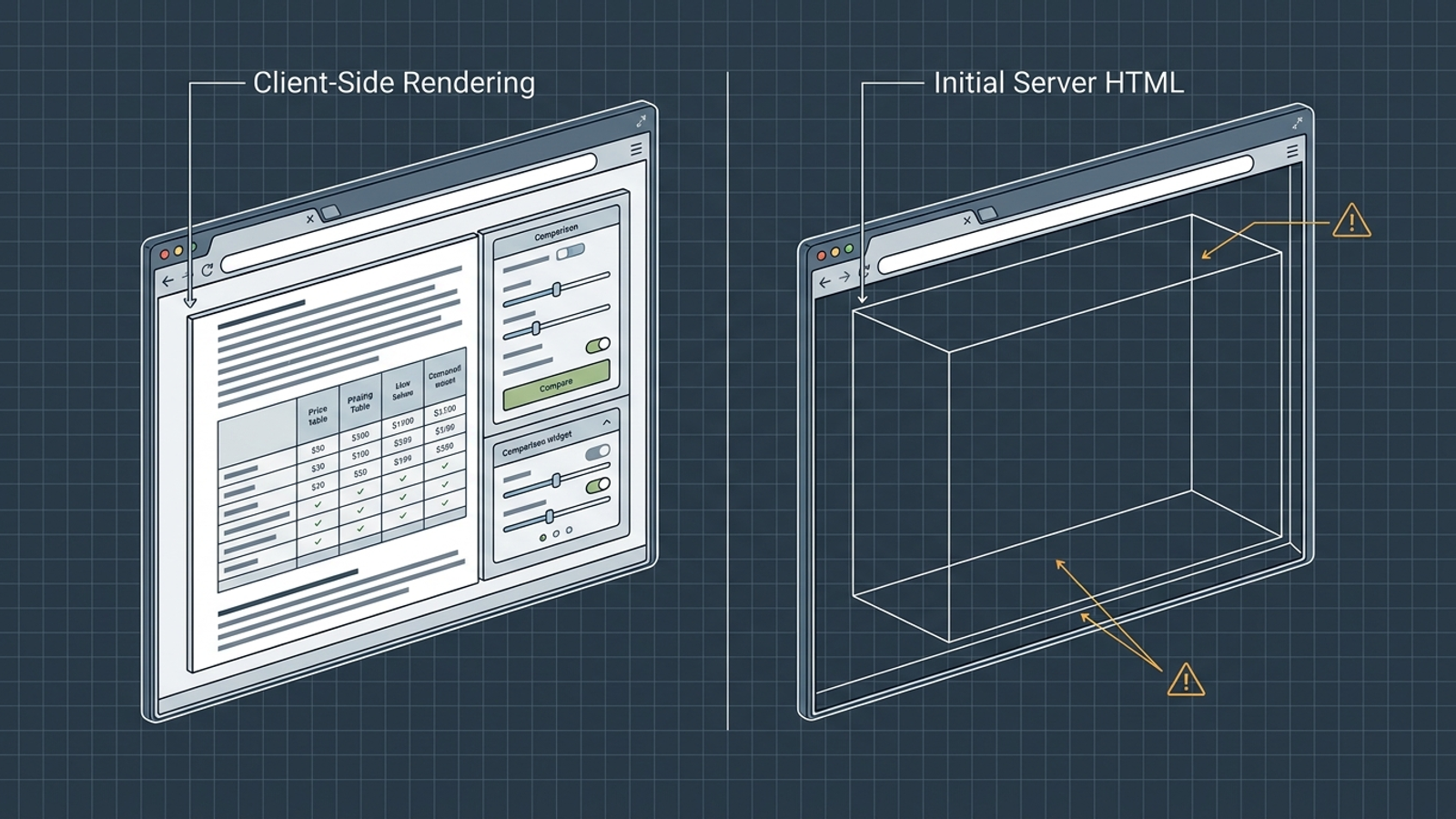
A WhyIQ technical audit guide flags a basic risk: if your core answer depends on client-side JavaScript, a retrieval crawler may not receive it in the initial HTML. Imagine spending $80,000 on a headless React migration only to put the content an engine needs behind asynchronous loading. The competitor’s plain, server-rendered page may be easier to read. No secret prompt formula required.
Your robots.txt file can create another barrier. A CapstonAI audit found that 41% of B2B sites blocked at least one major AI bot, including GPTBot, ClaudeBot, or PerplexityBot. The audit associated those blocks with lost citation potential and reported increased AI-attributed traffic after outdated directives were removed. Before treating a rival’s appearance as evidence of superior strategy, check whether your own site has shut the door.
Fetchability is not the whole story, either. An Ahrefs analysis found that 75.9% of ChatGPT’s brand-focused site searches targeted primary corporate domains. The broader footprint still matters when an engine checks claims against third-party sources such as G2, Capterra, GitHub, or Reddit. If your page is hard to fetch and nobody else substantiates what you do, a competitor with accessible pages and corroborating sources has the easier path to a citation.
Check the raw HTML, check crawler access, and check what independent sources say about you. Do that before buying a theory about your competitor’s genius.
“A content-gap report is the deliverable”
I understand the appeal of a colored matrix. Traditional keyword-gap reports gave teams a neat list of things to pursue. Now an AI visibility platform can hand you fifty questions where a competitor appears and you do not. It feels like progress because you can download it.
But a gap report is a diagnosis, not the finished work. Paying $1,200 a month to discover thirty unanswered buyer questions does not help much if no one can build, publish, and make those answers accessible. The report lands in the same ticket queue as everything else.

This is where advisory-only tooling and slow agency handoffs lose me. A dashboard can point to a missing pricing matrix. A strategy call can discuss a spec sheet that does not render for crawlers. Neither one puts an answer on the site. If a buyer needs a direct comparison, a crawlable page, and corroborating information elsewhere, execution is the deliverable.
That is the distinction behind groas: an autonomous growth engine pairs specialized machine execution with a named human strategist who sets direction and remains accountable. It is built to act on search work continuously rather than hand clients another dashboard of recommendations. Prompt probabilities are cheap to produce. The pages and search work that address the underlying gaps are not.
“I need the prompt list before I can start”
No. If you are about to buy a $1,500 monthly monitoring platform just to decide what to do on Monday, start with an operational triage instead. Use real buyer questions, then inspect the answers you already publish.
- Collect 20 questions from actual sales conversations. Ask sales reps, listen to recordings, or read closed-lost CRM notes. Prioritize questions that slow a decision: implementation timelines, pricing floors, integration limitations, compliance requirements, and comparisons with alternatives.
- Find the page that answers each question. Look for one URL that addresses it end to end. If a buyer has to follow three links, wade through generalities, and submit a form for the essential detail, mark it as an answer gap rather than a missing keyword.
- Check whether that answer can be fetched. Inspect a core evaluation page in a raw-text browser or disable JavaScript in developer tools. If its pricing or comparison information disappears, investigate before commissioning more copy. Check whether AI can read your site, then inspect
robots.txtfor outdated blocks affectingGPTBot,PerplexityBot, orClaudeBot.
That sequence will not tell you every prompt a stranger typed. It will tell you whether your business can answer the questions that matter and whether an engine can reach those answers. That is a better place to spend the first week.
“Brand citations will always be the metric that matters”
This is the belief I am still not sure about. For now, performance marketers watch whether their company appears in bullet three of a ChatGPT recommendation. I get it: an organic AI citation feels like a page-one Google rank used to feel. It is visible, countable, and easy to put on a slide.
But if autonomous agents increasingly carry out workflows and conversational advertising auctions develop, passive citation tracking may prove to be a temporary measure of something more valuable. If an agent can book software or order components using structured endpoints and verified transaction history, an informational citation in a chat window may matter less than being ready for the transaction.
I would not stop checking citations today. I would stop treating a citation count—or a 500-prompt spreadsheet—as the asset itself. Build direct, crawlable answers to hard buyer questions now. Whether tomorrow’s commercial decision happens in a chat answer or somewhere an agent can act, I am not yet sure which metric will best capture the value of that work.