

 LinkedIn
Dear client: Your brand appeared in 3 of our 100 AI-search queries, so I have prepared 94 slides explaining your absence. The PDF costs $9,995. Fixing the absence is available under a separate scope of work.
Welcome to Generative Engine Optimization & AI Readiness Diagnostic: Phase 1. Please view it at full resolution. Several of the gradients took considerable time to approve.
Act I: The Cover Page Protects the Findings
Slide one establishes the gravity of the occasion. The background is obsidian black, punctuated by a faint iridescent blob in the upper-right corner to signal advanced algorithmic cognition. Across the center sits the title: Your Brand’s AI Readiness Journey: Navigating the Synthesized Search Horizon. A semi-transparent crimson CONFIDENTIAL & PROPRIETARY watermark guards the document. This is important. Without the watermark, someone might mistake our findings for public information they could gather with a browser and a ChatGPT tab.
Below the title sits the metadata block: engagement code GEO-2026-Q2-ALPHA, a timestamp accurate to the second, and five contributors with titles including “Director of Prompt Topology” and “Generative Narrative Strategist.” At the bottom, in six-point gray type, the disclaimer explains that this is a “point-in-time assessment of probabilistic generative outputs” and does not guarantee brand retrieval. We encourage you to read that sentence after reviewing the invoice. The precision of the timestamp must not be confused with the reliability of the conclusion. It tells you when we stopped looking, not whether the answer would survive another run.
Please proceed to slide two. It has a chart.
Act II: The Executive Summary Discovers a Runway
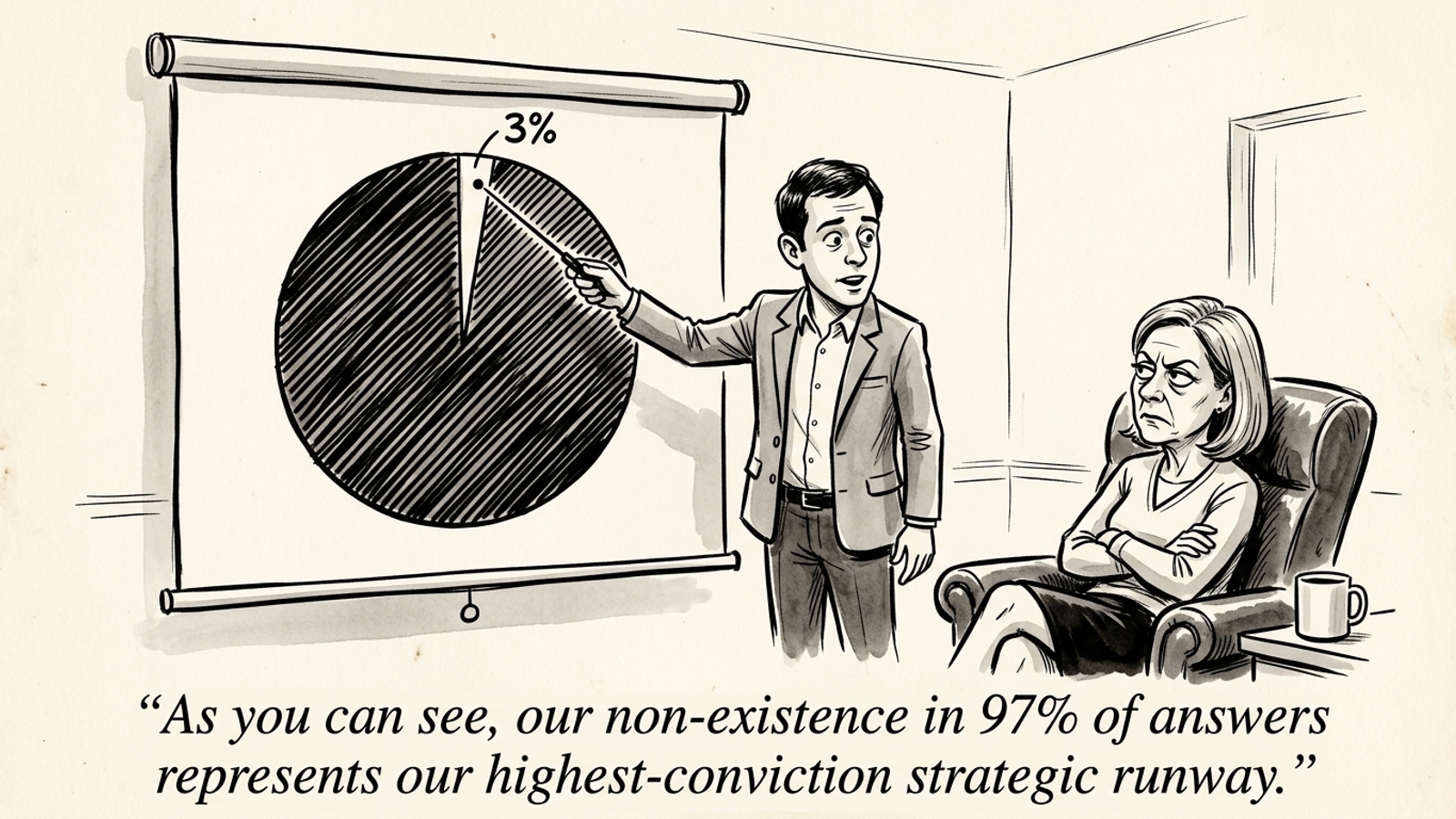
Your flagship B2B platform appeared in 3 of 100 benchmark queries across ChatGPT, Perplexity, and Claude. We have labeled the other 97 queries “an immense runway for narrative capture.” A crimson doughnut chart illustrates this opportunity by making almost the entire doughnut crimson. Beside it, a pull quote announces: The generative void presents our highest-conviction surface for strategic entity positioning.
The benchmark was collected once. Generative answers can vary between runs, which is why a serious measurement plan would repeat the queries rather than treat one scrape as a permanent census. The audit framework includes a useful word for that last step: prove. We will return to it once we have finished displaying the doughnut. Repeating the same buyer questions later would also tell us whether anything changed after publication. At present, there is no publication date to put on the chart.
Slide three introduces The Synthetic Visibility Index™. Your score is 41 out of 100. Forty-one is carefully positioned: low enough to command a meeting, high enough to suggest that the next meeting might help. On page 88, an asterisk explains the calculation. We averaged prompt presence, a subjective “brand sentiment affinity” grade, and a deduction for missing schema on an old corporate announcement. The composite score looks actionable until you ask which action would change it.
Beside the score, 32 competitor cells glow sage green. Yours is emergency crimson. This heat map borrows its emotional architecture from the Google Ads account audit: identify a problem, make the mechanism look forbiddingly intricate, then leave the client to wonder whether touching the account without supervision will bring down the domain. I remember that operating model. The colors have improved.
Please retain the score for your records. We have not assigned anyone to improve it.
Act III: The Findings Produce 212 Opportunities
Slide 14 opens The Entity Optimization Opportunity Matrix: 212 recommendations across four priority tiers: Urgent, Strategic, Foundational, and Exploratory. This is the centerpiece of the engagement. Every item has a color. None has an owner, an engineering estimate, or a published URL. An opportunity becomes a deliverable at the moment it enters the matrix, not the moment anything changes on your site. The matrix can be sorted by priority, which is useful if you need to decide which unassigned task to admire first.
Forty slides repeat variations of “Consider adding Schema.org/SoftwareApplication markup to legacy product pages.” Another section contains roughly 20 slides of JSON-LD pasted into Figma code boxes. This follows the venerable tradition of the AEO audit deliverable: present code as a visual asset, then assume someone else will turn it into working code. We recommend that the executive team not paste untested strings into production between board meetings. We also recommend that someone paste something somewhere eventually. The distinction between suggested markup and working markup is not a design detail. It is the part where a page has to change.

Next come eight slides devoted to a possible crawler catastrophe. Our diagnostic engine detected that your domain might be restricting generative retrieval bots. The deck promotes this possibility to a P0 emergency before showing a bot request or a blocked URL. That promotion is the service. For context, a study of 442 B2B SaaS robots.txt files found that 4.8% blocked any AI crawler and fewer than 1% blocked retrieval bots such as OAI-SearchBot. Those figures cannot clear your site; they cannot convict it, either. A server log would help. It would also be difficult to fit on the slide without shrinking the gradient. Until someone checks a request against a URL, “possible crawler catastrophe” remains a caption, not a diagnosis.
The technical appendix catalogs redirects, server response times, and missing OpenGraph tags, then requests that your engineering team submit 86 remediation tickets. We have not checked its backlog capacity. We do note that a tool with no direct line into the CMS cannot make a website change merely by describing one. If you need to fix technical SEO issues that hurt AI visibility, somebody must own the fix, implement it, and check the live page. A paragraph headed “Immediate Remediation” does none of those jobs.
Please mark the appendix complete. The website remains available for future work.
Act IV: The Prompt Universe Contains No Answers
Slides 52 through 71 present The Prompt Topology Map: buyer queries arranged in concentric pastel rings labeled “Awareness Horizon,” “Consideration Vector,” and “Decision Node.” At the center sit questions about pricing comparisons, API limits, compliance certifications, and implementation friction. These are useful questions. They are also questions a prospective buyer would need answered before choosing your product.
The map stops there. It supplies no draft answers, revised comparison tables, or passages ready for publication. If you ask what platform shows the content gaps preventing your business from being cited by AI, the map replies with a handsome diagram of those gaps. We have inventoried the missing answers without producing an answer. It is a museum of buyer intent, with nobody assigned to open the shop. A pricing question needs a usable pricing answer; moving its label from the outer ring to the inner ring does not supply one.
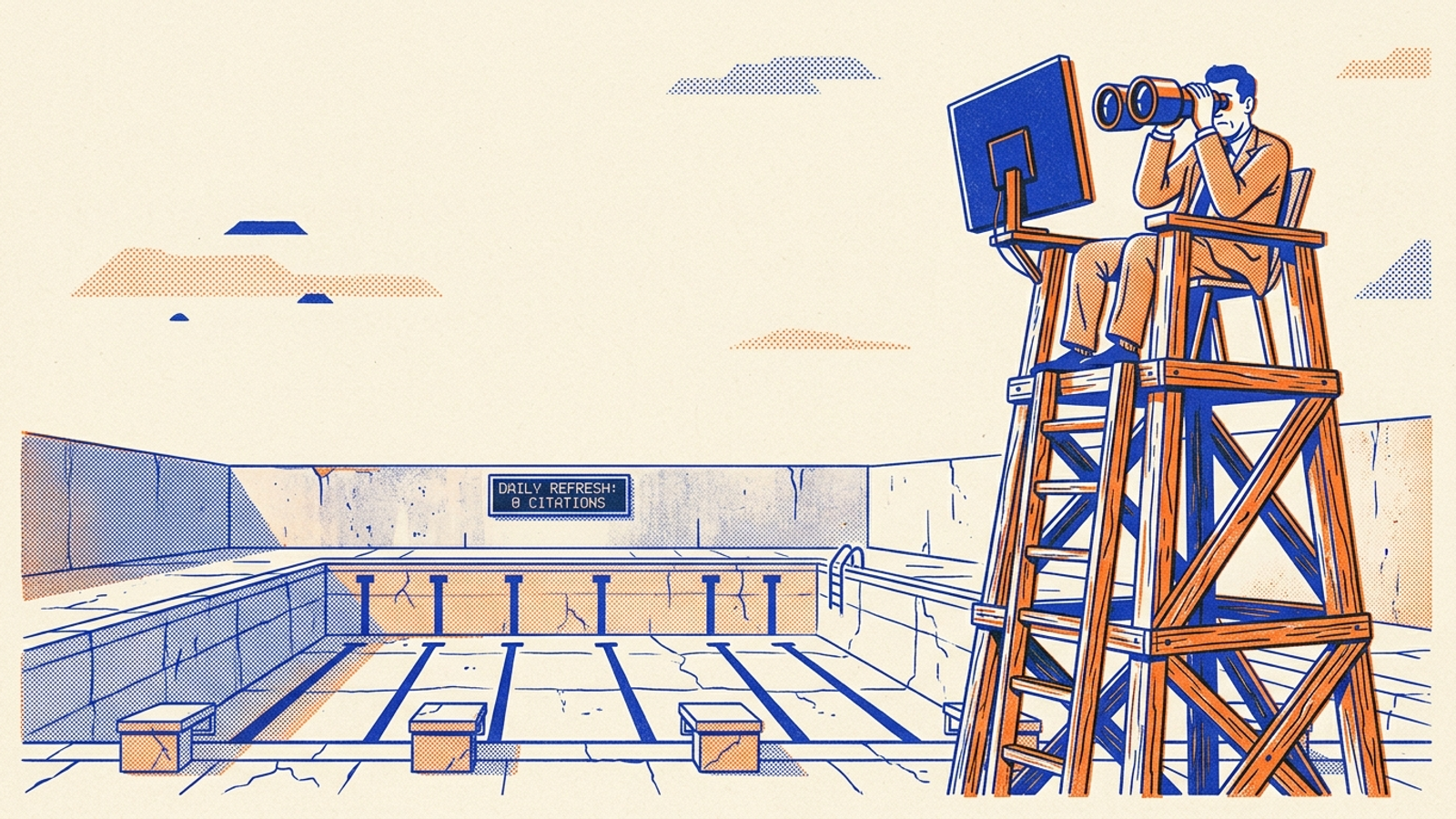
Slide 72 introduces the monitoring layer. Visibility trackers average $337 per month, with enterprise tiers above $700; the proposed dashboard refreshes every 24 hours. It offers the familiar sparklines, citation percentages, and sentiment gauges across AI answer engines. On Tuesday, your team can see that Perplexity did not cite you. On Thursday, it can confirm the same result. On Friday, it can export a CSV for the executive team. The website will have changed only if somebody changed it.
Monitoring matters when it tells an operator whether shipped work made a difference. Here it chiefly makes the absence easier to watch. Tracking an empty room daily does not furnish it.
Please leave notifications on. They will provide continuity between invoices.
Act V: Next Steps Offer to Shepherd the Roadmap
Slide 91 is titled Operationalizing the Synthesized Horizon. Having delivered 212 unbuilt tasks for $9,995, we propose a $6,500 monthly advisory retainer with a six-month commitment. Our senior narrative architects will “shepherd the operational roadmap.” The proposed scope does not include writing copy, editing your CMS, configuring schema, or building external citations. It includes a twice-monthly, 30-minute call to review ticket status and an audit re-run on day 90 to “quantify the delta.” The re-run can measure change. The scope does not say who will make any.
To be clear, a meeting can help settle priorities. It cannot publish a comparison page, repair a redirect, or supply a missing answer about your product. The old paid-search version of this arrangement worked much the same way: charge for an account audit, hand over a list of negative keywords, then wait for someone else to add them. I spent years in Google Ads accounts. When junk terms burned budget, the useful action was to add the negatives and check what happened afterward. Match-type theory looked excellent in a presentation, but it did not stop the spend.
Generative search has given that arrangement a new vocabulary. What the deck calls an “execution pathway,” I call a list of things nobody has done. This is the 2015 PPC audit with a new logo: the client pays for a description of work, then pays again for help discussing why the work is still open.
Our next available advisory slot can be reserved immediately. Production access is not required.
Curtain: The Acceptance Checklist
This final page is provided for clients who insist on judging a diagnostic by what reaches production. Some AEO audits repeat familiar SEO checks under a new label; that does not make every check useless. It means the label cannot substitute for an owner, a live change, and a way to inspect the result. The following five items define what I would accept before treating this PDF as operational work:
- Name the commercial evaluation prompts. Test buyer decision questions, not only broad informational or branded queries.
- Identify the missing answer for each prompt. Point to the absent specification, pricing detail, or comparison rather than requesting “more comprehensive content.”
- Assign the fix and its production path. A proposed schema snippet or copy change is not a deployed fix; identify who can publish it and where.
- Verify the revised URL is accessible. Check the live page and, where available, crawler requests before declaring a retrieval problem solved.
- Repeat the prompt tests after publication. Date the runs and compare actual citations; a single screenshot cannot establish movement.
For a shorter version of this checklist, compare tools that help you get featured in Google AI Overviews with tools that only report whether you appeared. Neither a dashboard nor a draft earns credit for work it has not put in front of a buyer. That is why groas is built around continuous execution across paid and organic search, with specialized AI models doing campaign, content, and optimization work and a named human strategist accountable for direction. The point is not to make the report prettier. It is to move work out of the report.
The item most often skipped is the production path. Without an owner who can put the answer on a live, crawlable URL, the 212 opportunities remain 212 rows in a PDF. The fee buys a diagnosis; the delay leaves buyer questions unanswered and gives competitors more chances to be cited.
Stop paying for a description of the work and pay for the work to get done.